- Client
- Spring EQ, Conshohocken, PA
- Licensed
- 48 states, NMLS #1464945
- Platform
- Umbraco Cloud, Umbraco Forms, HubSpot CRM
- Launched
- August 2026
- 3 months
- from kickoff to the HubSpot launch, with the new brand applied
- 9
- page types composed from one widget library, carried across both platforms
- 3
- workstreams running concurrently against one design system
- 0
- components redesigned when the site moved from HubSpot to Umbraco
Spring EQ
Home equity lending, 48 states
Spring EQ is a home equity specialist headquartered in Conshohocken, Pennsylvania. Founded in 2016 and licensed in 48 states, the company competes principally on speed of execution, with funding available in as few as 11 days. Its product set comprises fixed-rate HELOCs, variable-rate HELOCs, home equity loans and refinance. Spring EQ reports having served more than 150,000 homeowners and unlocked over $15 billion in equity.
Home equity lending is a crowded, rate-driven and heavily regulated market in which competing lenders present similar propositions through similar digital experiences. Spring EQ's brief included a stated objective to challenge that sameness.
Spring EQ selected Scandia following a competitive pitch against a considerably larger agency. The selection turned on direct access to the people doing the work and on a technical conversation that accounted for the company's in-house IT roadmap.
One design, two platforms
Why the work was sequenced this way
Spring EQ's marketing team operated inside HubSpot and could not stand down for the length of a CMS migration. Scandia proposed a two-phase engagement in which one design investment would be implemented on two platforms in sequence. Phase one delivered the brand and the front end on the existing HubSpot CMS, putting the marketing team inside the new site immediately. Phase two rebuilt the same experience on Umbraco Cloud.
HubSpot was selected as a practical starting point with known limits. The proposal recorded that it presents long-term limitations in performance, scalability and customization. Phase two was planned from the outset, and the modularity that made it affordable was established at proposal stage.
The original proposal stated that the approach was intentionally modular, so that components designed and built in the first phase could be reused and extended in later ones.
Phase two therefore rebuilt the platform and left the design intact.
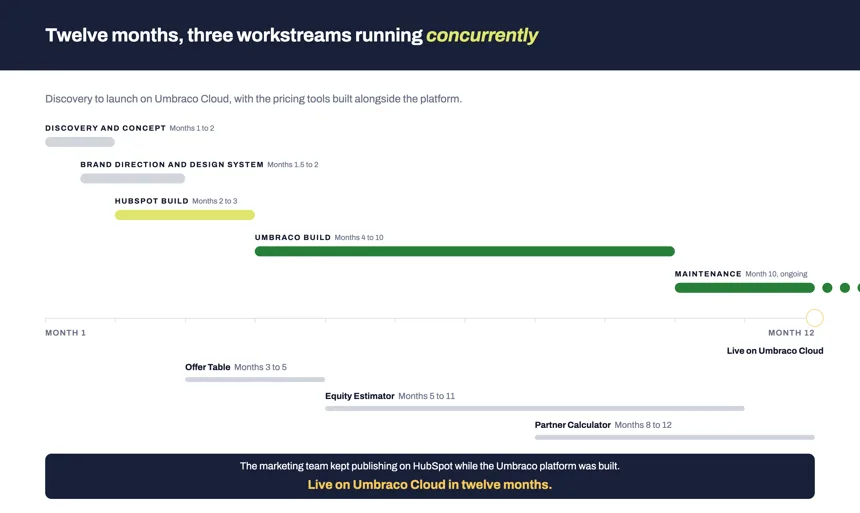
The phases overlapped. While the HubSpot build was in progress, a second team was integrating with Spring EQ's internal pricing endpoint to produce the Offer Table, and a third was developing the Equity Estimator. The Umbraco implementation began before either pricing tool was complete. Scandia ran three concurrent workstreams against one design system and one point of client contact.
Brand direction, wireframes and the component inventory
Two visual identity concepts, nine page types
The engagement opened with stakeholder interviews, a review of existing brand material, and a restructure of the sitemap and top-level navigation. Scandia produced annotated wireframes and interactive prototypes for the core page types.
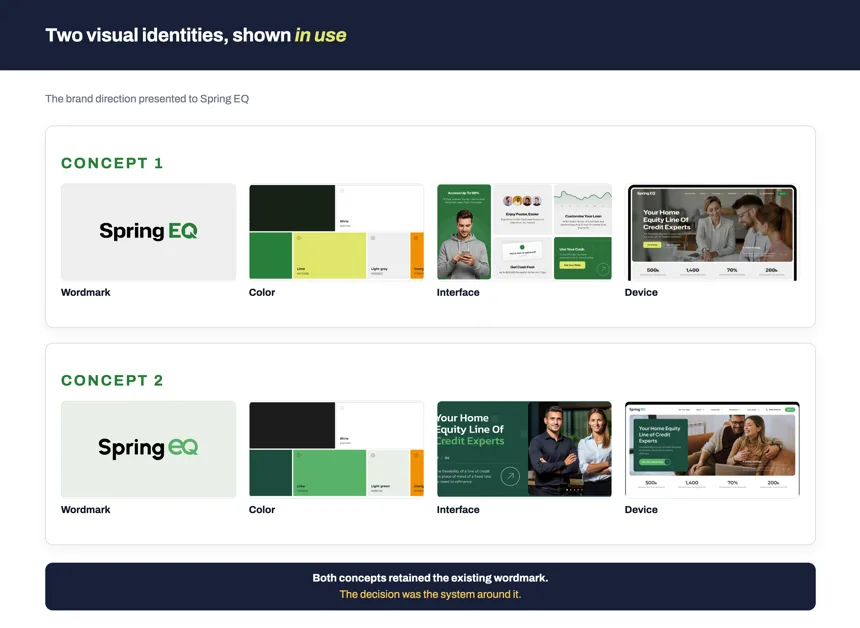
Brand direction was presented as two complete visual identity concepts. Each carried its own typography, color system, wordmark treatment, photography direction, iconography and graphic pattern, and each was shown applied to real interface elements including product cards, rate presentation and a device view. Spring EQ was therefore choosing between two working systems, not between two logos on a white page, and could see how each would behave on the pages it would eventually have to fill.
A retained wordmark and a new visual system
Both concepts retained the existing Spring EQ wordmark. What was open for decision was color, typography, imagery, spacing and the visual language applied to every component. The selected direction combined elements of both concepts and was developed into refreshed brand guidelines in Figma.
A design system, not a set of page comps
The chosen direction was developed into a full responsive design system across desktop, tablet and mobile, planned and built to WCAG 2.2 AA. It was the reference for both platform implementations and remains the single source of truth for the site today.
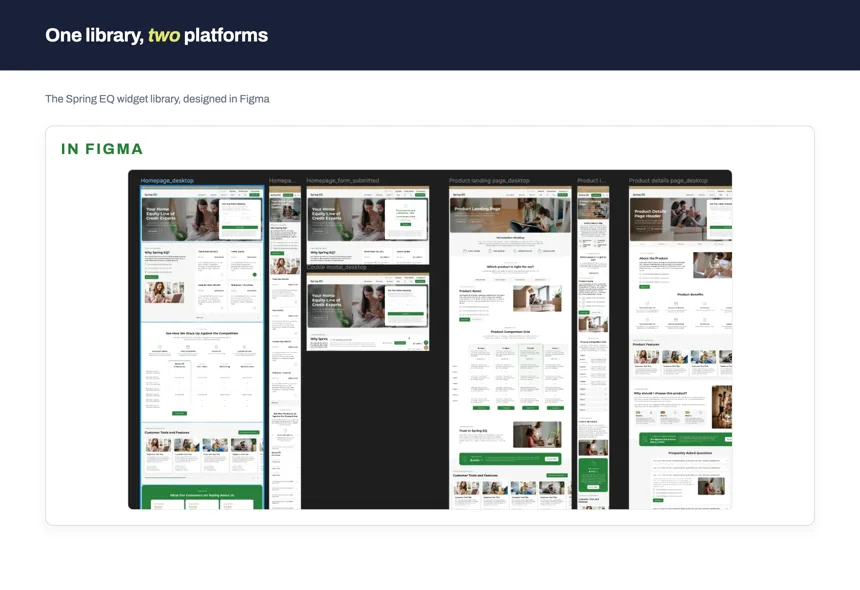
Scandia designed a catalogue of components. Nine page types were composed from a named widget library: home, product landing, product details, lead generation landing, blog, blog detail, careers, navigation and a flexible general content page. The library included hero variants, a product comparison grid, rate callouts and rates tables, customer tools and features, testimonials, awards and accreditations, FAQ blocks, related products, related news sliders, on-page and sticky progressive forms, contact and two-column callouts, and partner site links.
The lead generation landing page was specified from the start as an aggregation of widgets drawn from other pages, and blog body content on the same basis. Nothing in the library was tied to a single page.
Phase one, live on HubSpot in three months
HubL, Design Manager, 30 days HyperCare
Scandia built custom master templates in HubSpot using HubL and the native Design Manager toolchain, working in parallel with the live content so the existing site stayed up throughout. Staging and production environments were established, and Google Tag Manager and Google Analytics were integrated with defined key events and custom reporting.
Kickoff to go-live ran approximately three months, followed by 30 days of HyperCare. The marketing team received a new brand and a new site without first absorbing a platform migration, and worked inside it for the whole of the Umbraco build.
For regulated lenders
Replatform without taking marketing offline
Scandia sequences CMS migrations so the marketing team keeps working throughout. The design investment is made once and carried onto the destination platform.
Phase two, the Umbraco build
Six months, planned with Spring EQ's Director of Web Strategy
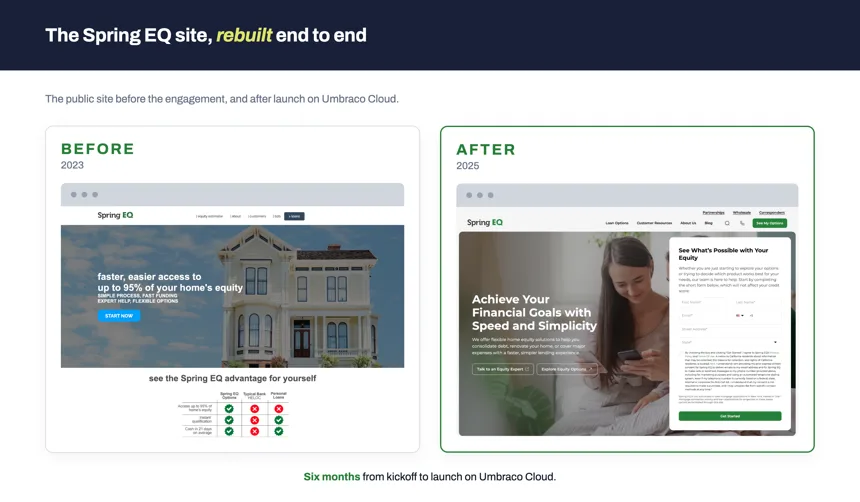
Phase two ran approximately six months and was planned in collaboration with Spring EQ's Director of Web Strategy. It moved content models, templates, widgets, forms and search onto Umbraco, migrated the media library out of HubSpot, and established a platform on which new products, campaigns and landing page variants no longer require development work.
Scandia's Umbraco implementations are built on a block-based grid. Every component in the Figma design system was implemented as an Umbraco block with its own editing schema, and editors place those blocks into grid rows configured as one column, two columns (even, weighted left, or weighted right), or three columns. Because the library was developed for Spring EQ's content, each block is modeled on the business domain it serves. The rate callout is structured around a featured rate. The product comparison grid is structured around the fields a HELOC row requires. Shared content allows a block to be authored once and referenced wherever it appears, so a disclosure or a promotional message is updated in one place.
Umbraco Forms, integrated with HubSpot
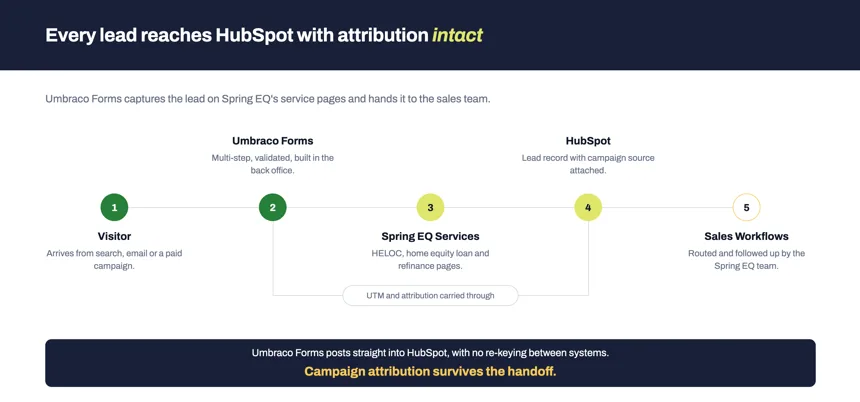
Changing the CMS did not require changing the CRM. Umbraco Forms became the capture layer, integrated with HubSpot so every submission continues to reach the workflows, lists, attribution and reporting the marketing and sales teams already depend on. Custom Umbraco Forms workflows were developed to support Spring EQ's multi-step progressive capture pattern, in which a sticky hero form initiates the interaction and hands off to the full flow. Tracking, UTM and attribution data is carried through and written back with the lead. Where a page calls for it, a HubSpot form can also be embedded directly.
Structured content published as machine-readable markup
Articles and reports are modeled as first-class document types in Umbraco, each carrying its own metadata, categories and tags, with the publishing organization and the named author held as structured references. Because the content is structured at source, the site emits Article, Organization and Person markup automatically across every qualifying page, with no editorial intervention.
Content migration, training and cutover
Content pages were created and populated in Umbraco, media was migrated out of HubSpot, and the Spring EQ team was trained on the widget library before go-live. DNS was cut over from HubSpot to Umbraco Cloud in August 2026, followed by a hypercare period.
No premium upcharge
Umbraco Forms and Deploy are included under Scandia's Gold Partner agreement.
Environments at no platform cost
QA, UAT and feature environments for compliance review cycles and campaign testing.
One-hour response at high severity
Continuous monitoring with UptimeRobot alerting and PagerDuty escalation.
Results
What the marketing team can now do
www.springeq.com runs on Umbraco Cloud, hosted under Scandia's Gold Partner umbrella account. Spring EQ remains Organization Owner, and all content, data and intellectual property remain entirely Spring EQ's.
Marketing never went offline
The team worked inside the new brand on a familiar platform throughout the Umbraco build. No campaign was paused for the migration.
The design survived the platform change
The entire phase one component library carried into the Umbraco build. No component required redesign, and the Figma design system remains the single source of truth for both implementations.
Campaign pages are an editorial task
Producing a new campaign or product landing page no longer requires a development request. Editors compose from the widget library directly.
Lead capture continued across the cutover
Umbraco Forms feeds HubSpot, so CRM workflows, attribution and reporting continued without interruption through the DNS window.
Technical notes
- Umbraco CMS 17.6 on Umbraco Cloud, hosted under Scandia's Gold Partner umbrella account, with Spring EQ retaining Organization Owner status
- Phase one built on HubSpot CMS using HubL and custom master templates in Design Manager
- Block-based grid supporting one column, two column (even and weighted) and three column rows, with a purpose-built widget library and shared content references
- Umbraco Forms with custom workflows for progressive multi-step capture, integrated with HubSpot for lead creation and attribution write-back, with direct HubSpot form embedding where required
- Articles and reports modeled as first-class document types and published with Article, Organization and Person structured data
- Mainline Staging to Live, with additional QA, UAT and feature environments available at no incremental Cloud cost
- Built and tested to WCAG 2.2 AA, verified cross-browser and cross-device through BrowserStack
- Continuous monitoring through UptimeRobot with PagerDuty escalation against a defined severity matrix
- The Equity Estimator runs on a separate Azure App Service with SigNoz monitoring, deployable independently of the marketing site